Signed in as:
filler@godaddy.com
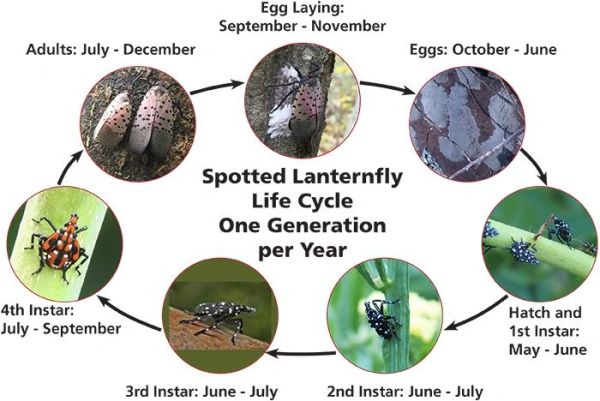
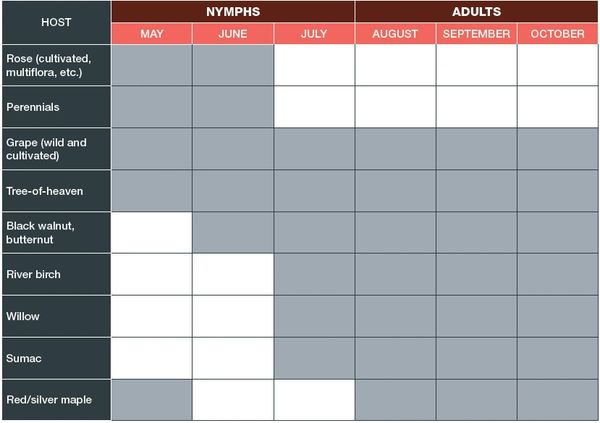
Spotted Lanternfly, Lycorma delicatula, is an invasive insect native to Asia. Spotted Lanternfly (SLF) was originally found in the United States in Pennsylvania and was believed to be introduced and spread initially through the plant trade. It is now found in at least 19 states and feeds mainly on an invasive tree species, Tree-of-Heaven, Ailanthus altissima. Although SLF prefers Tree-of-Heaven, it has also been found to feed on black walnut, willow, and maples in different stages of the lanternfly’s lifecycle. The chart below can be helpful to determine what plants SLF can be found on throughout their lifecycle.
Read more about Spotted Lanternfly:
In areas with high SLF infestations, trees can suffer from major carbohydrate loss compromising health and growth. SLF feeding can also cause reduced photosynthesis and nutrient levels making trees more susceptible to other diseases and drought (Penn State Extension). Additionally, SLF infestations cause tree wilting and a moldy understory due to their secretion of sticky, sweet honeydew when feeding on sap from trees. Many industries in Indiana like forestry, logging, and wineries are likely to be the most affected by SLF spread. Economists from the Penn State College of Agricultural Sciences estimate that the current economic loss due to SLF is around $50 million within Pennsylvania with major impacts on forestry and wineries (Penn State University).

Check these places for common egg mass locations:
Do regular checks in wintertime for egg masses! If you see an egg mass report it to INDNR and destroy them!
To Destroy Egg Masses:

Download the EDDMapS Pro app to your phone.
Log in or create an account.
See an invasive species? Take several photos of the identifying characteristics of the plant/animal/insect.
Click the + in the right corner of the app. Choose a point or polygon (for large infestations).
Choose the invasive species, add photos, and fill out any other information you have. Make sure to save your observation.
Click the three bars in the upper left corner of the app, go to upload queue, press upload all files.