Signed in as:
filler@godaddy.com
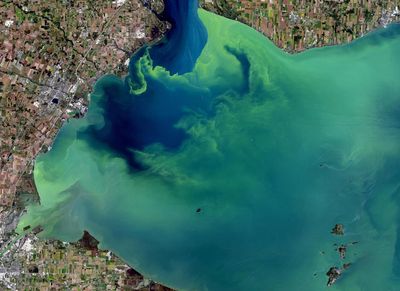
When nutrients enter waterways, they create a boom of growth of algae, often leading to consequences for other species.
The consequences of nutrient pollution are eutrophication, which presents itself as low levels of oxygen in the water, creating dead zones. These dead zones are exactly what they sound like; nothing can survive in these areas.
Pictured right: Algae blooms in Lake Erie by Earth Resources Observation and Science Center.

Careful management of your lawn's fertility is critical for keeping nearby and downstream aquatic ecosystems clean and healthy.
If applying fertilizer, these practices can reduce nutrient runoff.

A soil test provides useful information about the health of your soil. Common tests can describe your soil's nutrient content and pH. This information comes in handy for determining whether fertilizer would benefit your lawn.
Conservation district staff can offer advice on how to test your soil and help translate the results into a nutrient management plan.
Unless a soil test shows a deficiency in your lawn, it is best to use a zero-phosphorus fertilizer to avoid the application of phosphorus. Phosphorus is usually the most limiting nutrient in aquatic systems and therefor the major cause of algae blooms.
The nutrient content of a fertilizer is usually formatted numbers for N-P-K; the N for Nitrogen, P for Phosphorus, and K for Potassium (sometimes referred to as potash). The ratio is presented in percentages of the product's weight. For example, a fertilizer with a ratio of 16-4-8 is 16% Nitrogen, 4% Phosphorus, and 8% Potassium.
Reducing runoff can be as easy as changing the type of fertilizer you are applying to your lawn. Slow-release fertilizers that include water insoluble nitrogen (WIN) release nutrients gradually requiring less application needed.
Organic or natural fertilizers, such as compost and organic granular fertilizer, can be used as an alternative to synthetic fertilizers. They help in reducing nutrient leaching and help improve the health of your soil.
The big reason for nutrient runoff happening is rainwater carrying excess nutrients that do not get absorbed by the soil. Never fertilize before heavy rains as potential is highest during storm events.
Leaving the fresh clippings of grass after mowing your lawn allows the nutrients in the plant to return to the soil. This reduces the need to apply fertilizer.
This strategy is important for fertilizing on areas that border and or near any bodies of water. When creating a buffer zone, do not fertilize within 10ft - 25ft of open water.
Fertilizer has the chance to be spread on not only the lawn, but on sidewalks, driveways, and other forms of pavement. Sweep up any excess fertilizer from the pavements and properly dispose of it to ensure the excess does not create runoff.
Native perennial plants have deeper, more extensive roots than the ornamental flowers often used in landscaping. They can intercept and filter nutrients that would otherwise degrade water quality.
Native plants are also the foundation of a healthy ecosystem providing food and shelter for beneficial insects and other wildlife.
Similar to native flowers, native shrubs are the heavy duty buffers. They lock up nutrients in their wood for decades, preventing it from ever reaching the water.